








How Do 2026 Ram Commercial Vehicles Qualify for Section 179?
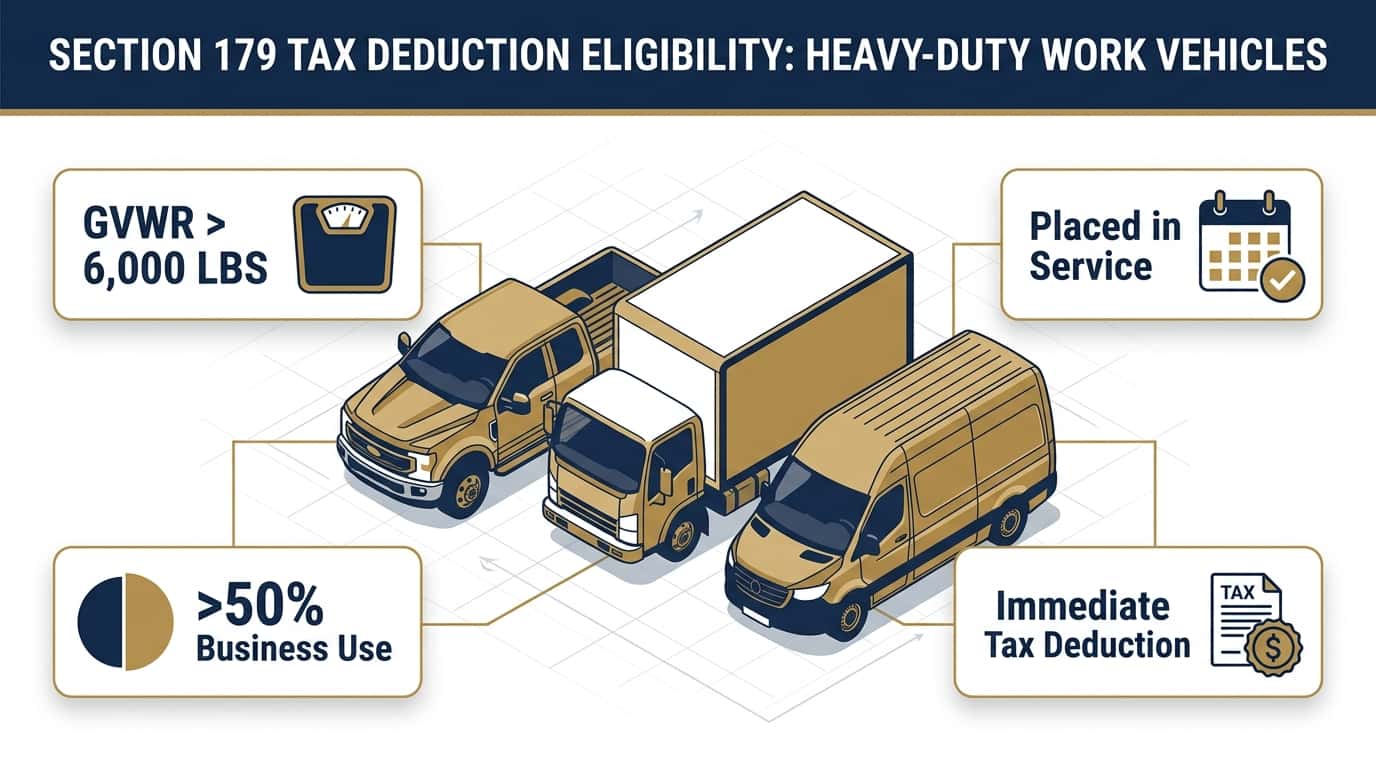
Commercial Ram vehicles qualify for the Section 179 tax deduction when acquired and placed in service for more than 50% business use within the tax year. Vehicles with a Gross Vehicle Weight Rating (GVWR) exceeding 6,000 lbs—such as heavy pickups, chassis cabs, and dedicated cargo vans— eligible businesses can deduct up to $2,560,000 of the purchase price in tax year 2026. Eligible vehicles in our commercial lineup include most configurations of the 2026 RAM 1500 Tradesman Crew Cab and Quad Cab, the heavy-duty 2026 RAM 2500 Tradesman, and the full-size 2026 RAM ProMaster Cargo Van.
Qualifying a commercial truck or van for this tax incentive requires meeting three core Internal Revenue Service criteria: business ownership, active placement in service by December 31, and gross weight verification. When a company purchases or finances a eligible vehicle, the federal government allows the taxpayer to write off the cost as an immediate expense rather than depreciating it over a standard five-year recovery schedule.
For business owners operating out of distribution parks in City Of Industry, acquiring heavy-duty work vehicles allows for immediate capital recovery during the same tax cycle the capital expense occurs. To confirm that your vehicle purchase aligns with your company’s tax strategies, our team at West Covina Chrysler Dodge Jeep Ram | Pinnacle Auto Group can walk you through exact factory specifications. You can visit our West Covina commercial vehicle center or speak directly with our commercial vehicle experts by calling (626) 746-3132.
Table of Contents
- What Is the 2026 Section 179 Limit and GVWR Requirement for Commercial Ram Vehicles?
- What Vehicles Qualify for the Full Section 179 Tax Deduction Versus the Heavy SUV Cap?
- Does the Ram ProMaster Qualify for a Full Section 179 Write-Off for Commercial Fleet Operators?
- What Happens If a Ram Truck Weighs Less Than 6,000 lbs GVWR?
- Can a TRAC Lease or Used Commercial Ram Truck Qualify for Section 179 Deductions?
- What Documentation Is Required and How Do You Claim Your Commercial Ram Tax Savings?
- Key Section 179 Tax Answers for Commercial Ram Buyers
- Upgrade Your Commercial Fleet at West Covina Chrysler Dodge Jeep Ram | Pinnacle Auto Group
What Is the 2026 Section 179 Limit and GVWR Requirement for Commercial Ram Vehicles?
For tax year 2026, the maximum Section 179 deduction cap rises to $2,560,000, with a total equipment purchase phase-out threshold beginning at $4,090,000. To unlock the full heavy vehicle deduction, a commercial Ram truck or van must carry an official GVWR rating of more than 6,000 lbs.
The GVWR represents the maximum allowable gross weight of the vehicle when fully loaded with passengers, fluids, equipment, and payload. This figure is determined by the manufacturer and is stamped on the safety compliance certification label inside the driver-side door jamb. The 2026 RAM 2500 Tradesman equipped with the 6.4L HEMI V8 engine easily exceeds this threshold, boasting a gross weight rating well above the minimum standard.
Businesses acquiring multiple fleet assets can take advantage of the combined purchasing cap. Once total qualifying equipment purchases cross $4,090,000, the deduction phases out dollar-for-dollar until it is fully eliminated at $6,650,000. Additionally, the passage of P.L. 119-21 reinstated 100% bonus depreciation for qualifying property acquired and placed in service after January 19, 2025. This allows commercial operators to write off remaining basis amounts that exceed initial expensing caps.
Exploring our broad inventory of new Ram commercial models gives business owners direct access to models that qualify for these elevated deduction thresholds. Companies seeking pre-owned commercial assets can also explore our certified pre-owned commercial lineup to find work-ready trucks that meet federal weight criteria.
What Vehicles Qualify for the Full Section 179 Tax Deduction Versus the Heavy SUV Cap?
Full tax deductions apply to commercial trucks with beds longer than 6 feet and cargo vans without rear seating, whereas passenger-oriented vehicles weighing between 6,001 lbs GVWR and 14,000 lbs GVWR are subject to a $32,000 heavy SUV cap for tax year 2026.
The IRS maintains distinct categories for vehicles based on physical design and intended operational purpose:
- Heavy Commercial Trucks & Vans: Pickups with an interior cargo bed length of at least 6 feet, passenger vans seating more than 9, and cargo vans with a fully enclosed driver compartment and no rear seating (such as the 2026 RAM ProMaster Cargo Van) are exempt from the heavy SUV limitation. These models can utilize the full $2,560,000 deduction limit up to their business-use percentage.
- Passenger SUVs & Heavy Crossovers: Vehicles with a GVWR between 6,001 lbs and 14,000 lbs designed primarily for passenger transport are restricted to a maximum Section 179 write-off of $32,000. Any remaining cost basis must be recovered through applicable bonus depreciation and standard Modified Accelerated Cost Recovery System (MACRS) five-year depreciation schedules.
For local contractors navigating foothill work sites in Claremont, choosing a dedicated work truck like the 2026 RAM 1500 Tradesman or a heavy-duty pickup avoids the SUV tax cap entirely while providing maximum towing and payload performance. Business owners looking to upgrade their fleet can lower upfront acquisition costs by evaluating your current trade-in value to apply toward a new work truck purchase.
Does the Ram ProMaster Qualify for a Full Section 179 Write-Off for Commercial Fleet Operators?
Yes, the 2026 RAM ProMaster Cargo Van qualifies for a 100% Section 179 expensing write-off because its GVWR exceeds 6,000 lbs and its open cargo bay lacks rear passenger seating behind the front row.
Because the IRS classifies cargo vans without rear seats as dedicated work vehicles, the 2026 RAM ProMaster Cargo Van escapes the $32,000 SUV cap completely. Powered by a 3.6L Pentastar V6 paired with an 8-speed automatic transmission, the ProMaster delivers a high-capacity cargo hold engineered specifically for trade professionals, delivery fleets, and service contractors.
Commercial buyers evaluating the 2026 RAM ProMaster Cargo Van on our lot usually check the safety compliance certification label inside the driver-side door jamb first to verify the vehicle’s exact gross weight rating before reviewing their tax strategy. Because the ProMaster meets both the gross weight threshold and the structural commercial design test, business owners using the van 100% for business can write off its entire purchase cost in year one, provided total business income supports the election.
What Happens If a Ram Truck Weighs Less Than 6,000 lbs GVWR?
When a Ram truck carries a GVWR of 6,000 lbs or less, it fails to meet the federal heavy vehicle classification and becomes subject to IRS Section 280F luxury passenger automobile depreciation rules.
Under Section 280F, light-duty passenger vehicles are restricted to strict annual depreciation caps rather than full upfront expensing. For light-duty trucks weighing under the 6,000 lbs GVWR threshold, the first-year write-off is capped at a fraction of the vehicle’s total purchase price, forcing the business to depreciate the balance over five to six tax years.
The operational differences between light-duty and heavy-duty classifications highlight why weight ratings matter to fleet managers:
- Deduction Limits: Vehicles under 6,000 lbs GVWR cannot utilize the $2,560,000 Section 179 heavy vehicle limit or the $32,000 heavy SUV threshold.
- Depreciation Timeline: Cost recovery for light trucks is stretched over the standard MACRS five-year recovery period, limiting first-year tax relief.
- Payload & Utility Impact: Vehicles under 6,000 lbs GVWR typically offer lower payload capacities, whereas heavy-duty models like the 2026 RAM 2500 Tradesman deliver both superior work-site capability and complete Section 179 eligibility.
Can a TRAC Lease or Used Commercial Ram Truck Qualify for Section 179 Deductions?
Both Terminal Rental Adjustment Clause (TRAC) leases and pre-owned commercial Ram trucks qualify for Section 179 deductions, provided the vehicle is new to the taxpayer and put into active service during the tax year.
A TRAC lease is a specialized commercial vehicle agreement that treats the lessee as the owner for federal income tax purposes. Because the business retains the financial risks and rewards of ownership, the IRS allows the lessee to claim the Section 179 deduction on a qualifying commercial Ram truck or van. This setup allows fleet operators to combine low monthly lease payments with immediate first-year tax write-offs.
Pre-owned commercial vehicles are equally eligible for Section 179 expensing. As long as the used Ram truck was not previously owned by the business or a related entity, its purchase price can be written off up to the $2,560,000 limit. Exploring our selection of pre-owned commercial trucks allows growing companies to acquire heavy-duty equipment at competitive price points while maintaining tax write-off advantages. Business owners can initiate financing arrangements by submitting a confidential online credit application prior to visiting our dealership.
What Documentation Is Required and How Do You Claim Your Commercial Ram Tax Savings?
Claiming a Section 179 deduction on a commercial Ram truck requires filing IRS Form 4562 with your corporate or individual tax return and maintaining precise records of business usage.
To substantiate the tax deduction during an audit, business owners must maintain complete records verifying eligibility:
- Purchase Receipt & Invoice: Official bill of sale showing the purchase price, buyer name under the business entity, and date of acquisition.
- Door-Jamb Weight Verification: Documentation confirming the vehicle’s official GVWR exceeds 6,000 lbs.
- Mileage & Usage Logs: Detailed records tracking business versus personal miles to prove the vehicle was used more than 50% for qualified business operations.
- Form 4562 Filing: IRS Form 4562 (Depreciation and Amortization) completed and attached to your annual tax filing, electing Section 179 treatment under Part I.
Our finance professionals work directly with commercial clients and local CPAs to ensure all vehicle invoices clearly list model specifications and weight ratings. When you are ready to expand your fleet, stop by our Azusa Avenue showroom location or start the conversation by calling our finance team at (626) 746-3132.
Key Section 179 Tax Answers for Commercial Ram Buyers
Q: Can I claim Section 179 if I use my Ram truck for both personal and business trips?
Yes, you can claim a Section 179 deduction as long as your Ram truck is used more than 50% for legitimate business purposes. However, your allowable deduction is calculated based exclusively on the percentage of business use. For example, if you purchase a 2026 RAM 1500 Tradesman and use it 80% for business and 20% for personal driving, your deductible basis is 80% of the total vehicle acquisition cost.
Q: Does 100% bonus depreciation apply to new commercial Ram trucks in 2026?
Yes, 100% bonus depreciation applies to qualifying commercial vehicles acquired and placed in service after January 19, 2025, under P.L. 119-21. This allows business owners to deduct any remaining cost basis that exceeds the $2,560,000 Section 179 expensing limit during the first year of ownership, eliminating the need to spread depreciation over five tax years.
Q: Where can I locate the official GVWR on a Ram 1500 or Ram 2500?
The official GVWR rating is printed directly on the Safety Compliance Certification Label located on the driver-side door pillar. This gross weight rating includes the vehicle’s net weight plus its maximum payload capacity. Verifying this door-jamb label ensures your vehicle qualifies for heavy vehicle tax treatment before completing your purchase.
Q: Must a commercial Ram vehicle be purchased brand new to qualify for Section 179?
No, both new and pre-owned commercial Ram trucks qualify for Section 179 expensing. The key IRS requirement is that the vehicle must be “new to you,” meaning it cannot have been owned or used previously by you, your business, or a related business entity.
Q: What is the deadline to place a commercial vehicle in service for the 2026 tax year?
To claim the deduction on your 2026 tax return, the qualifying Ram commercial truck or van must be placed in service by December 31, 2026. “Placed in service” means the vehicle is fully acquired, registered, and actively available for business use on or before the last day of the calendar year.
Upgrade Your Commercial Fleet at West Covina Chrysler Dodge Jeep Ram
Capitalizing on Section 179 tax savings starts with selecting the right commercial truck or cargo van for your operational requirements. Whether your business needs the heavy-duty towing capacity of a 2026 RAM 2500 Tradesman or the expansive cargo space of a 2026 RAM ProMaster Cargo Van, West Covina Chrysler Dodge Jeep Ram stocks a full lineup of qualifying commercial work vehicles.
Our experienced commercial sales team understands the tax deadlines and technical weight requirements that drive smart business purchases. We can help you review vehicle specifications, confirm GVWR classifications, and structure commercial purchase or TRAC lease agreements that align with your financial goals. Take the next step toward upgrading your fleet by calling our commercial vehicle team at (626) 746-3132 or visiting our West Covina dealership to test drive a qualifying commercial Ram today.
Keep Your Vehicle Running Strong
Keep your vehicle performing at its best with our service team:
© 2026 West Covina Chrysler Dodge Jeep Ram | Pinnacle Auto Group. All rights reserved.

0 comment(s) so far on How Do 2026 Ram Commercial Vehicles Qualify for Section 179?