






Selecting the Right Jeep SUV and Truck Tires in West Covina California
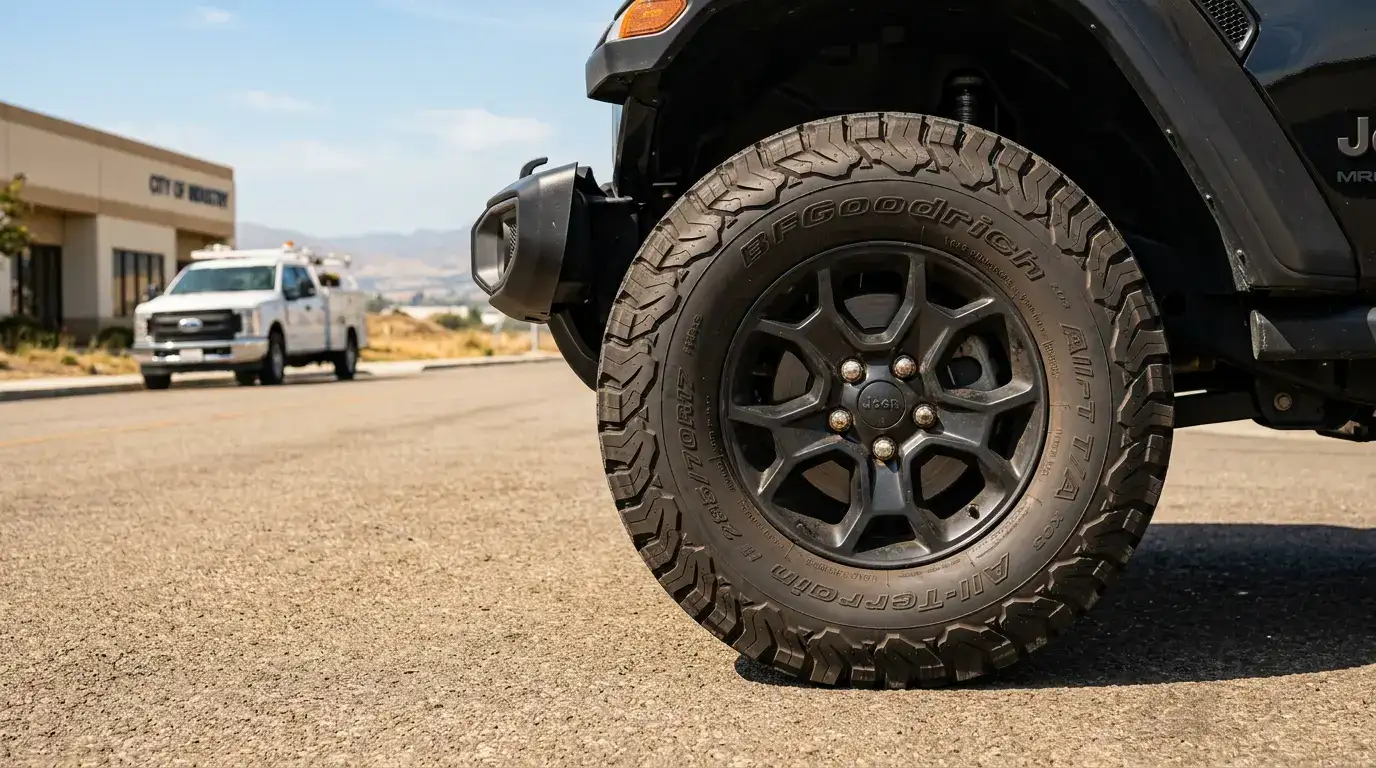
The performance, safety, and durability of your vehicle depend entirely on the rubber connecting it to the pavement. Southern California’s warm, dry climate and high ambient pavement temperatures can accelerate tire rubber aging and increase tread wear rates [4]. This is particularly true for heavier SUVs and trucks frequently driven on concrete freeways [4]. Ensuring your vehicle is equipped with the correct specification of tires is critical to maintaining traction and handling under these demanding local driving conditions.
When choosing tires for your vehicle, the selection process must balance daily driving requirements with any weekend recreation. For example, a driver commuting daily into City Of Industry for logistics or warehousing work requires a tire that can withstand heavy highway use, manage heat buildup on the freeway, and support the payload demands of a working vehicle. Selecting a tire with the proper load index and temperature resistance rating ensures that your vehicle remains stable and efficient during long, hot commutes.
Our team is dedicated to keeping your vehicle running safely and efficiently. If you are noticing signs of wear or simply need expert advice on the best replacement options for your specific model, we invite you to consult with our certified technicians. You can easily book an appointment using our online service scheduler to have your tires inspected. For those who prefer to speak with a specialist directly, please give our service department a quick call at (626) 746-3132. If you are ready to visit us for a professional tire consultation or physical inspection, you can find our service center location by getting directions to our West Covina service department.
Table of Contents
- Choosing Between All Terrain and Mud Terrain Tires for Commutes and Trails
- Common Stock and Upgrade Tire Sizes for Jeep Wrangler and Gladiator Models
- The Safety and Mechanical Realities of Running 35 Inch Tires on a Stock Jeep
- How Aggressive Off Road Tread Patterns Affect Street and Freeway Ride Quality
- Comparing Budget Tire Options with Premium All Terrain and Mud Terrain Brands
- Step by Step Tire Tread Inspections and Common Questions About Professional Care
- Quick Answers Before Your Visit
- Keep Your Vehicle Adventure Ready at West Covina Chrysler Dodge Jeep Ram
Choosing Between All Terrain and Mud Terrain Tires for Commutes and Trails
Are you trying to decide which tire style best fits your driving routine? Choosing the ideal tire for a mix of city driving and weekend off-roading requires understanding the technical design differences between All-Terrain (A/T) and Mud-Terrain (M/T) options. All-terrain tires are engineered as a compromise, typically targeting a 50/50 split between on-road refinement and off-road traction. They feature moderate tread blocks and narrower voids, which deliver a quieter ride on local freeways, longer tread life, and reliable wet traction. For daily driving, tires like the Pirelli Scorpion WeatherActive provide excellent wet grip and Three-Peak Mountain Snowflake winter certification, making them highly capable for highway use.
In contrast, mud-terrain tires are built for maximum off-road traction in extreme environments like deep mud, loose dirt, and jagged rocks. They are designed with aggressive, oversized tread blocks, reinforced sidewalls to prevent punctures, and wide self-cleaning channels to eject debris. However, these same design characteristics result in increased road noise, reduced fuel economy, and faster tread wear when driven continuously on paved freeways. For local drivers who enjoy exploring the rugged foothills and wilderness trails near Claremont, all-terrain tires are generally the most practical choice because they maintain daily ride comfort while still providing the necessary grip for weekend trail adventures.
Maintaining the integrity of your vehicle’s suspension and drivetrain during tire swaps means utilizing components designed specifically for your model. If you decide to transition from an all-season tire to a more aggressive all-terrain model, sourcing your parts through an authorized department ensures perfect compatibility. You can order correct-fit tires and matching heavy-duty wheel components directly through our genuine Mopar parts and accessories department to maintain factory-spec safety and performance.
Common Stock and Upgrade Tire Sizes for Jeep Wrangler and Gladiator Models
What tire sizes can your vehicle accommodate without compromising its mechanical safety? Jeep Wrangler and Jeep Gladiator models come from the factory with specific tire dimensions tailored to their individual trim levels and suspension setups. On 2018–2026 Jeep Wrangler JL and JLU models, the standard configurations vary significantly across the lineup [5]:
- Sport and Sport S trims typically feature 245/75R17 tires mounted on standard 17 x 7.5-inch wheels [5], [6].
- Sahara trims generally step up to a 255/70R18 tire size to accommodate larger 18-inch wheels [5].
- Rubicon, Rubicon X, and Rubicon 392 models utilize a larger, more aggressive 285/70R17 tire size (equivalent to a 33-inch tire) to maximize off-road ground clearance [5].
- Moab 392 specialty packages are equipped from the factory with massive 315/70R17 tires (equivalent to a 35-inch tire) [1].
Upgrading to a larger tire size is a popular modification for owners looking to improve off-road capability and ground clearance. A common upgrade path for Sport or Sahara owners is moving up to a 33-inch tire (285/70R17), which generally fits within the factory wheel wells without causing clearance issues during daily driving. However, moving beyond a 33-inch tire to a 35-inch or 37-inch tire introduces physical and mechanical changes that require careful planning and professional installation to prevent component damage.
The Safety and Mechanical Realities of Running 35 Inch Tires on a Stock Jeep
Is it safe to mount 35-inch tires on a stock Jeep Wrangler without modifying the suspension? While some late-model Wrangler trims with high-clearance fender flares (such as the Rubicon) can physically fit a 35-inch tire inside the wheel wells, doing so on a completely stock Sport or Sahara suspension is not recommended. Under normal driving conditions on flat pavement, the tires may seem to clear the bodywork. However, when the suspension articulates off-road, or during tight, full-lock turns on city streets, 35-inch tires will rub against the inner fender liners and suspension components, potentially damaging both the vehicle body and the tire tread.
To run 35-inch tires safely, a suspension lift kit of at least 2 inches is typically required. This lift provides the necessary clearance for full suspension travel and steering articulation. Beyond physical clearance, installing heavier 35-inch tires increases rotational mass and rolling resistance, which places additional stress on several critical mechanical systems:
- Braking System: The factory brakes must work harder to stop the increased rotational mass, which can lengthen stopping distances.
- Steering and Suspension: Ball joints, tie rods, and steering stabilizers experience accelerated wear due to the extra weight.
- Drivetrain and Gearing: Larger tires alter the effective gear ratio, which can make the vehicle feel sluggish during acceleration and cause the automatic transmission to hunt for gears on highway inclines. Re-gearing the differentials is often necessary to restore factory-like performance.
How Aggressive Off Road Tread Patterns Affect Street and Freeway Ride Quality
How does swapping out your factory tires for aggressive mud-terrain tires alter the daily driving experience? While deep, chunky tread blocks look rugged, they significantly change how a vehicle behaves on paved roads and local freeways. The large voids between mud-terrain tread blocks trap air as the tire rotates, creating a distinct humming or growling noise that becomes progressively louder at highway speeds. This increased cabin noise can impact passenger comfort during long daily commutes.
In addition to noise, aggressive off-road tread patterns alter the vehicle’s handling dynamics on asphalt. Because mud-terrain tires have a smaller contact patch (less rubber actually touching the flat pavement compared to an all-season tire), they generally deliver less grip on dry and wet roads. This can result in a slightly looser steering feel, reduced cornering stability, and longer braking distances. Furthermore, the heavier construction of off-road tires increases unsprung weight, which can make the ride feel stiffer and cause the suspension to react more harshly to potholes and expansion joints on the freeway.
Comparing Budget Tire Options with Premium All Terrain and Mud Terrain Brands
Should you buy budget-tier tires or invest in premium off-road rubber? When pricing out replacement tires, budget-oriented brands often present a lower upfront cost compared to premium offerings from established manufacturers like BFGoodrich, Goodyear, Falken, or Toyo. While budget tires may look similar on the surface, they often compromise on rubber compound technology, sidewall reinforcement, and tread design.
Premium tires utilize advanced, silica-infused rubber compounds that remain pliable in hot weather while resisting rapid tread wear [4]. They also feature multi-ply sidewall constructions designed to resist punctures from sharp rocks and trail debris. Budget tires, by contrast, may wear out significantly faster under the high pavement temperatures of Southern California, resulting in a shorter overall service life [4]. When you calculate the cost per mile, investing in a durable, premium tire often saves money over time because you will not need to replace them as frequently.
Step by Step Tire Tread Inspections and Common Questions About Professional Care
Regular maintenance is the most effective way to protect your tire investment and ensure your family’s safety on the road. Performing a monthly visual inspection of your tires allows you to spot potential issues before they lead to a flat tire or a hazardous blowout. Follow this straightforward step-by-step process to inspect your tread at home:
- Locate the Treadwear Indicators: Look inside the tread grooves for the built-in, raised rubber bars that run perpendicular to the tread pattern [3]. If the surrounding tread is worn down level with these indicators, your tires have reached the end of their usable life and must be replaced immediately [3].
- Perform the Penny Test: Insert a standard U.S. penny into the deepest groove of the tire with Abraham Lincoln’s head pointing down and facing you [3]. If the top of Lincoln’s head is fully visible, your tread depth is less than the safety threshold of 2/32 inch, meaning the tire is legally worn out and no longer safe for wet weather traction [3].
- Inspect for Uneven Wear: Run your hand across the tread width to feel for irregular wear patterns [3]. Cupping, feathering, or rapid wear on only one shoulder of the tire are classic indicators of wheel misalignment or improper balancing, which require professional service to correct [3].
- Check the Sidewalls: Examine both the inner and outer sidewalls for visible damage, including deep cuts, cracks, dry rot, or unusual bulges that could indicate an internal structural failure.
To maximize the life of your tires, tire manufacturers recommend rotating them every 5,000 to 7,500 miles to promote even wear [3]. If you are experiencing steering wheel vibration, uneven wear, or suspect your vehicle needs a professional alignment, our certified service team is here to help. For expert diagnostics and precision alignment services, drop by our service center or get directions to our Azusa Avenue service department. You can also speak with a service advisor directly to discuss your tire maintenance needs by calling us at (626) 746-3132.
Quick Answers Before Your Visit
Q: How often should I rotate the tires on my 4WD Jeep SUV or truck?
A: For 4WD vehicles frequently driven on road and off-road, we recommend rotating your tires every 5,000 to 7,500 miles to ensure even tread wear across both axles [3]. If you carry a matching, full-size spare tire on the back of your vehicle, asking for a 5-tire rotation pattern during your service visit is highly beneficial, as it integrates the spare into the rotation cycle and extends your overall tread life by roughly 20 percent.
Q: What is the official roadside assistance number if I experience a flat tire or blowout?
A: If you experience a tire emergency, flat tire, or blowout while on the road, you can contact the manufacturer-backed emergency service directly at Chrysler, Dodge, RAM, Jeep Roadside Assistance: 1-800-521-2779. This service is included with your vehicle’s warranty and provides professional towing or flat-tire assistance to an authorized service center using brand-certified technicians.
Q: Can I perform a wheel alignment at home after installing larger tires?
A: While basic steering wheel centering can be adjusted manually, a complete wheel alignment requires specialized, high-precision computerized equipment to properly measure and adjust caster, camber, and toe angles. Having a certified technician perform the alignment ensures your suspension geometry is perfectly calibrated, preventing rapid, uneven tire wear and maintaining stable highway handling.
Q: Why does my tire pressure warning light turn on during cooler mornings and then turn off later?
A: This is a common occurrence caused by temperature-induced pressure drops. As ambient temperatures fall overnight, the air pressure inside your tires contracts, which can trigger the Tire Pressure Monitoring System (TPMS) warning light. Once you begin driving, the friction of the tires against the road generates heat, raising the internal pressure back above the warning threshold and extinguishing the dashboard light.
Q: What is the minimum safe tread depth for driving in wet or rainy conditions?
A: Although the legal limit for worn tires is 2/32 inch [3], driving in heavy rain with tread this shallow significantly increases the risk of hydroplaning. For reliable wet-weather traction and safe stopping distances on wet concrete freeways, tire manufacturers recommend replacing your tires before the tread wears below 4/32 inch.
Keep Your Vehicle Adventure Ready at West Covina Chrysler Dodge Jeep Ram
Maintaining your vehicle’s tires is one of the most critical aspects of ownership care. From routine tire rotations and computerized wheel alignments to complete replacements, our factory-trained technicians have the specialized tools and expertise to keep your vehicle performing at its best. We stock a comprehensive selection of premium, brand-name tires designed specifically for the weight, suspension, and performance characteristics of your SUV or truck.
Do not wait for a flat tire or an unexpected blowout to address your tire health. If you have noticed uneven tread wear, a persistent vibration in your steering wheel, or if your tires are approaching their mileage limit, let our professional service team handle the job. Book your next maintenance visit online today using our convenient scheduler, or stop by our service center on Azusa Avenue to ensure your vehicle remains safe, efficient, and ready for whatever road or trail lies ahead.
© 2026 West Covina Chrysler Dodge Jeep Ram | Pinnacle Auto Group. All rights reserved.

0 comment(s) so far on Selecting the Right Jeep SUV and Truck Tires in West Covina California