







Jeep brake service near Downey, California
When Should You Get Your Jeep’s Brakes Serviced?
Jeep vehicles require a comprehensive brake system inspection at every routine oil change interval, or at least every 5,000 to 7,500 miles, with brake fluid flushes called for every two years. Brake pads generally require replacement between 30,000 and 70,000 miles depending on vehicle weight, terrain, and individual driving habits, while immediate professional inspection is mandatory whenever unusual grinding sounds, soft pedal travel, or pulling occurs.
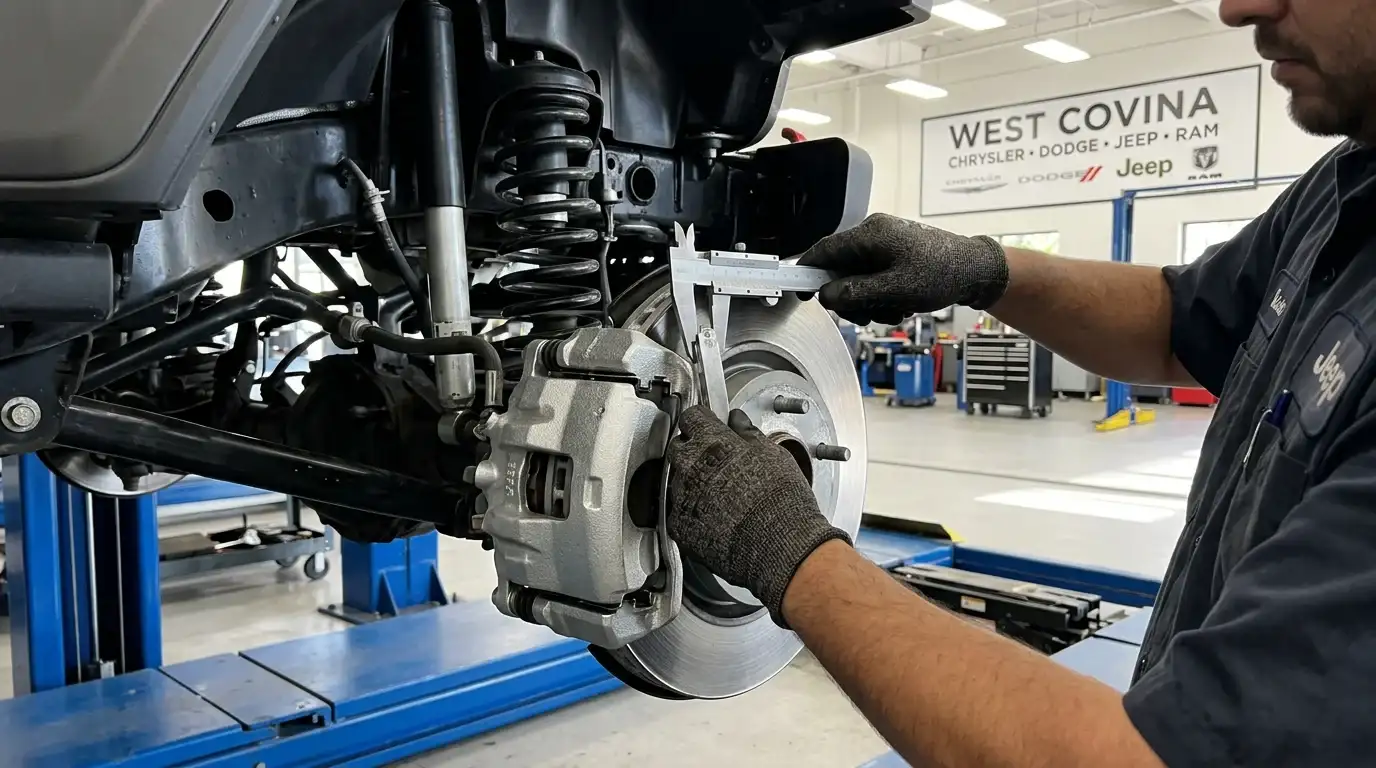
Maintaining the braking components on an SUV like the 2026 Jeep Wrangler or pickup truck like the 2026 Jeep Gladiator requires adhering to a structured preventive schedule. Factory maintenance guidelines specify checking pad thickness, rotor surface condition, caliper hardware, hydraulic hoses, and parking brake function during every regular service visit. SUVs that carry heavy passenger loads or engage in regular off-road trail driving put extra thermal stress on friction materials, making routine checks vital for maintaining optimal stopping distances.
Monitoring wear between scheduled maintenance visits helps prevent minor pad thinning from escalating into costly rotor damage or hydraulic component failure. Drivers traveling through Southern California traffic should stay attentive to subtle changes in pedal feel or stopping performance. If you are experiencing any brake issues, you can stop by our West Covina service center for a complete multi-point brake check, or give our service team a quick call to discuss any symptoms your vehicle is showing.
Table of Contents
- What Are the Common Warning Signs That a Jeep Needs Brake Service?
- How Much Does a Jeep Brake Pad and Rotor Replacement Cost on Average?
- How Do Ceramic Brake Pads Compare to Semi-Metallic Brake Pads on Jeep SUVs?
- Do Aftermarket Brake Pads Void the Manufacturer Warranty on Your Jeep?
- How Often Should Jeep Brake Fluid Be Flushed and Replaced?
- Frequently Asked Questions About Jeep Brake Maintenance
- Where Can You Get Official Mopar Jeep Brake Service Near Downey?
What Are the Common Warning Signs That a Jeep Needs Brake Service?
Common warning signs of worn or compromised Jeep brakes include high-pitched squealing, harsh metal-on-metal grinding, a spongy or sinking brake pedal, vehicle pulling to one side under deceleration, and an illuminated ABS or brake warning light. Experiencing any of these indicators signifies that key friction or hydraulic components require immediate professional diagnosis and service.
A high-pitched squeal while applying the brakes usually originates from built-in acoustic wear indicators on the brake pads. These small metal tabs contact the spinning rotor disc when pad material wears down to a critical thickness, alerting the driver that replacement is due. If this squeal is ignored, the pad friction material wears away entirely, leading to a deep grinding noise. Grinding indicates that the bare steel backing plate of the pad is pressing directly against the iron rotor disc, causing rapid scoring and thermal damage that destroys the rotor.
Changes in brake pedal feel point directly to hydraulic or mechanical issues within the braking circuit:
- A soft or spongy pedal that travels further down than usual indicates air or moisture contamination within the brake lines, or a failing master cylinder seal.
- A hard pedal that requires excessive foot pressure to slow the vehicle suggests a loss of vacuum assist from the power brake booster.
- A pulsating brake pedal or steering wheel vibration during high-speed deceleration points to uneven rotor surface thickness, often called rotor warping.
- Pulling to one side during braking occurs when a caliper slide pin seizes or an internal piston sticks, applying uneven clamping force across the front axle.
Addressing these symptoms early preserves vehicle safety and prevents secondary damage to surrounding suspension and wheel hub assemblies. For convenient service access, owners can handle maintenance planning by scheduling a certified brake inspection online before minor wear turns into major repair needs.
How Much Does a Jeep Brake Pad and Rotor Replacement Cost on Average?
Replacing Jeep brake pads and rotors generally costs between $350 and $650 per axle, depending on model configuration, axle placement, and part specifications. Front axle service sits at the higher end of that price spectrum because front brakes handle up to 70 percent of total vehicle stopping force and utilize larger rotors, multi-piston calipers, and heavy-duty friction materials.
Several technical variables influence the final investment required for a complete brake job:
- Component Sizing: Larger vehicles like the 2026 Jeep Grand Cherokee rely on broad-diameter ventilated rotors to dissipate extreme thermal energy, which naturally require higher material costs than smaller compact crossovers.
- Friction Formulations: Premium semi-metallic or ceramic pad compounds engineered for low dust and high heat resistance carry a slight price premium over basic organic alternatives but deliver far superior durability.
- Rotor Condition: If discs retain adequate thickness above minimum discard specifications, resurfacing on a precision lathe offers an economical alternative to complete rotor replacement. However, severe scoring or heat cracking mandates fitting new rotors.
- Hardware and Sensor Replacement: Modern brake service includes fitting new caliper anti-rattle clips, slider boots, and wear sensors to ensure smooth pad movement and eliminate nuisance noises.
Choosing genuine Mopar brake pads and rotors guarantees that replacement components match factory dimensions, friction coefficients, and heat dissipation capabilities precisely. Factory-certified technicians follow exact torque specifications during reassembly, preventing premature wear and ensuring long-term system reliability.
How Do Ceramic Brake Pads Compare to Semi-Metallic Brake Pads on Jeep SUVs?
Ceramic brake pads deliver low dust, whisper-quiet operation, and extended friction life for daily suburban commuting, while semi-metallic brake pads offer higher thermal conductivity and stronger cold-bite stopping power under heavy towing or off-road conditions. Selecting the right pad compound depends directly on how you utilize your vehicle.
Ceramic pads are composed of dense ceramic compounds intermixed with fine copper or aluminum fibers. They excel in daily driving environments because they produce light-colored, non-abrasive dust that does not stick heavily to alloy wheels. Ceramic material operates quietly across a wide temperature spectrum and wears slowly, making it an ideal match for smooth daily driving.
Semi-metallic pads consist of 30 to 65 percent steel, iron, and graphite metal matrix mixes. This metallic composition transfers heat away from the braking interface rapidly, preventing brake fade during demanding tasks. For example, a 2026 Jeep Grand Cherokee configured with a 2.0L engine and TorqueFlite® transmission boasts a maximum towing capacity of 6,200 lbs. When pulling heavy trailers or descending steep foothill grades around Claremont, semi-metallic pads maintain consistent clamping friction even as rotor temperatures soar.
| Feature | Ceramic Brake Pads | Semi-Metallic Brake Pads |
|---|---|---|
| Primary Benefit | Quiet operation & low dust | High heat tolerance & strong bite |
| Ideal Application | Daily urban/suburban commuting | Heavy towing & severe off-roading |
| Rotor Wear Rate | Very low rotor wear | Moderate rotor wear |
| Cold-Bite Performance | Moderate initial bite | High initial bite |
| Dust Characteristics | Light-colored, non-stick dust | Darker, metallic brake dust |
Do Aftermarket Brake Pads Void the Manufacturer Warranty on Your Jeep?
Installing aftermarket brake pads does not void your vehicle’s factory warranty under federal protection laws like the Magnuson-Moss Warranty Act. The manufacturer or dealership cannot deny coverage for a vehicle repair simply because a non-OEM component is present, unless that specific aftermarket part directly caused the failure in question.
If an aftermarket brake pad fails, damages a caliper piston, or causes premature rotor scoring, the manufacturer can decline warranty repairs for those damaged braking components. However, unrelated warranty coverage—such as engine electronics, transmission operation, or interior climate systems—remains entirely unaffected.
Using factory-certified Mopar brake components provides clear operational advantages over third-party alternatives:
- Exact Engineering Fit: Factory pads match the specific piston diameter, caliper bridge clearance, and anti-rattle hardware designed for your vehicle’s exact trim level.
- Matched Metallurgy: Mopar friction compounds are formulated to pair with factory rotor metallurgical densities, preventing uneven pad transfer layers and squealing.
- System Integration: Original equipment components preserve precise calibration with electronic stability control systems, hill descent assist, and emergency automated braking systems.
How Often Should Jeep Brake Fluid Be Flushed and Replaced?
Jeep recommends flushing and replacing brake fluid every two years or approximately 20,000 to 30,000 miles to preserve hydraulic performance. Regular flushes remove absorbed moisture from the closed hydraulic network before corrosion damages internal caliper pistons, ABS valves, and the master cylinder.
Automotive brake fluid is hygroscopic, meaning it actively absorbs atmospheric moisture through micro-pores in rubber brake lines and reservoir seals over time. As water content in the fluid increases, several performance issues emerge:
- Reduced Boiling Point: Fresh DOT 3 or DOT 4 fluid exhibits a dry boiling point well above 400 degrees Fahrenheit. Water contamination lowers this threshold significantly, causing fluid to boil into compressible steam vapor during sustained heavy braking on commercial corridors in City Of Industry. This results in sudden, severe pedal fade.
- Internal System Corrosion: Water inside steel hydraulic lines and cast-iron calipers creates localized rust and corrosion products that scratch internal seals and jam sensitive Anti-lock Braking System (ABS) hydraulic control valves.
- Fluid Oxidation: Contaminated fluid darkens from clear or amber to dark brown, losing its lubricating properties for internal moving components and seals.
Periodic fluid exchanges remove dark, oxidized fluid and moisture, restoring crisp brake pedal response and protecting high-cost electronic brake hardware.
Frequently Asked Questions About Jeep Brake Maintenance
Q: How long does a standard Jeep brake pad and rotor service take at a service center?
A routine front or rear brake pad and rotor replacement typically takes between 1.5 and 3 hours to complete at a certified service center. This time frame allows technicians to perform a full system inspection, clean and lubricate caliper slide pins, flush air from localized hydraulic lines, torque wheel lug nuts to factory specification, and conduct a controlled road test to seat the new friction pads onto the rotors properly.
Q: Can an electronic parking brake interfere with replacing rear brake pads on newer Jeep models?
Late-model Jeep vehicles equipped with an electronic parking brake require placing the rear brake system into a dedicated service mode via a diagnostic tool or vehicle menu sequence prior to servicing. This retracts the internal electric motor spindle inside the rear caliper piston. Forcing the caliper piston back manually without engaging service mode will crack the internal motor housing and destroy the electronic parking brake assembly.
Q: What is the difference between rotor resurfacing and complete rotor replacement?
Rotor resurfacing involves mounting the iron rotor disc onto a precision brake lathe to machine away a micro-thin layer of metal, creating a fresh, smooth friction surface for new pads. Resurfacing is only viable if the rotor disc remains thicker than the manufacturer’s minimum discard limit after turning. Complete replacement becomes mandatory when rotors fall below minimum thickness, exhibit severe heat cracking, or display deep rust pitting.
Q: Why do my Jeep brakes squeal in the morning even when pads are relatively new?
Light morning squealing often occurs due to a thin layer of flash rust or environmental moisture forming overnight on iron rotor discs, particularly after damp weather or vehicle washing. This light noise is normal and usually disappears after the first two or three brake applications, which sweeps the surface rust off the rotors. Persistent squealing throughout a drive indicates dry caliper hardware or worn friction pads.
Q: Does Jeep 4xe plug-in hybrid regenerative braking affect brake pad wear?
Regenerative braking on Jeep 4xe models utilizes the electric drive motor to slow the vehicle while capturing kinetic energy, which significantly reduces physical brake pad wear during daily driving. However, hydraulic friction brakes still require routine inspections and fluid service because traditional calipers can suffer from slide-pin sticking or pad surface glazing if they remain under-utilized over long periods.
Where Can You Get Official Mopar Jeep Brake Service Near Downey?
For official Mopar brake maintenance, certified technicians, and genuine factory components, West Covina Chrysler Dodge Jeep Ram provides complete service care for your vehicle. Our dedicated service department uses factory diagnostic tools, specialized brake lathes, and original equipment Mopar friction parts to restore factory braking performance.
Whether your vehicle needs routine pad replacement, rotor resurfacing, or a complete hydraulic fluid flush, our factory-trained technicians ensure every service meets exact brand guidelines. We invite you to visit our West Covina service center at 298 N Azusa Ave, West Covina, CA 91791 to keep your braking system performing reliably. You can also (626) 746-3132 to speak directly with a service advisor, check current maintenance specials, or reserve your next service appointment.
© 2026 West Covina Chrysler Dodge Jeep Ram | Pinnacle Auto Group. All rights reserved.
0 comment(s) so far on Jeep brake service near Downey, California